
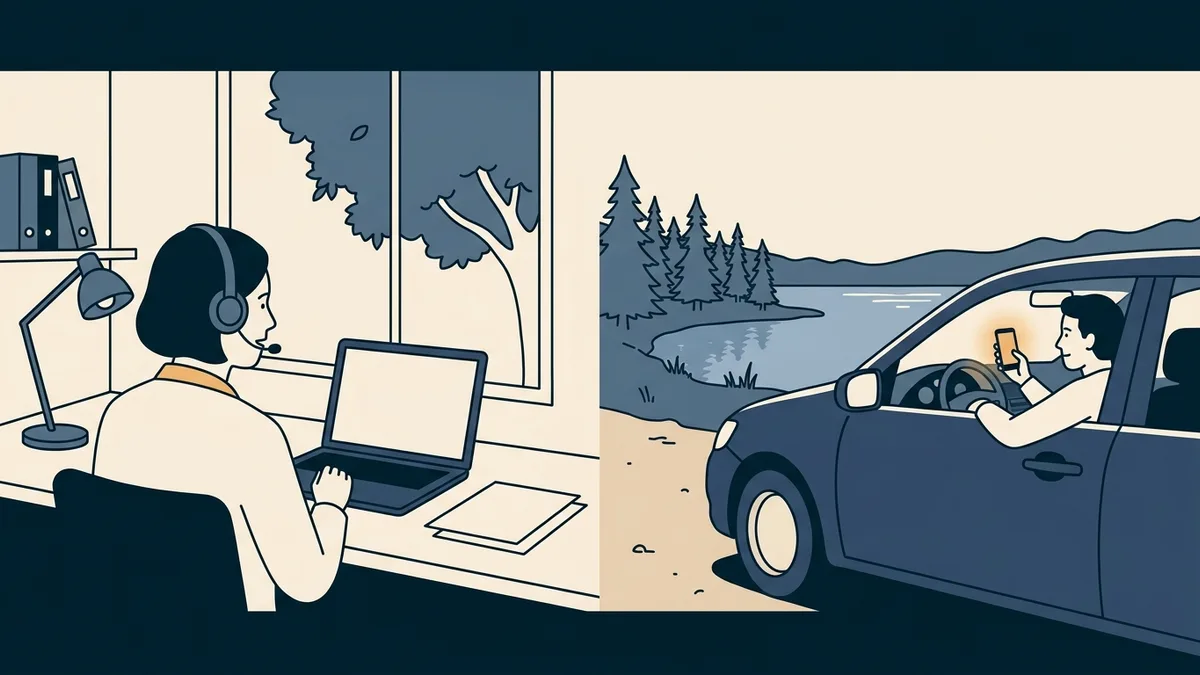
Social work telehealth is regulated where the client is located during the session. You need a license, an applicable exception or, once issued, a multistate license covering that state. That applies to LCSWs and LMSWs, and often to case managers who present as social workers. Exceptions exist in a few states, such as California and Maryland, but are narrow.
Social workers ask us about telehealth across state lines more than any other topic, and most of the questions have the same answer: the client's location at the time of the session decides which state's license you need. Your office, your home, your employer's headquarters and the client's permanent address do not.
Why the client's location decides
States regulate the practice of social work within their borders, and they treat a service delivered to someone physically in the state as practice in the state. Boards say this in plain terms. New York's State Education Department: "Licensure in another jurisdiction does not authorize you to practice in New York whether services are provided in-person, by telephone, over the Internet, or any other format." Maryland's Board of Social Work Examiners tells out-of-state social workers that to provide teletherapy to a client located in Maryland, "you will need to obtain a Maryland social work license," and that "the Maryland Board does not have provisional or temporary licenses."
The Social Work Licensure Compact builds the same rule in. A multistate license holder must "abide by the laws, regulations, and applicable standards in the Member State where the client is located at the time care is rendered."
What this means for an LCSW providing therapy
Every session needs authorization in the state where the client is during that session. In practice:
- Ask where the client is, every session. Record it. Clients move, travel and work from second homes, and they rarely think to tell you.
- Hold a license in each state where clients regularly are. If a client lives in one state and spends half the year in another, you need both, or an exception that covers the second.
- Follow that state's rules, not your home state's. Duty-to-warn standards, minors' consent, mandated reporting, record retention and telehealth consent requirements differ, and the client's state governs.
What about an LMSW?
Two layers apply. First, the same location rule: you need authorization in the client's state. Second, scope: what your license allows depends on that state's law. If the client's state reserves psychotherapy or diagnosis for clinical licensees, a master's license there does not authorize it, even if your home state's LMSW allows supervised clinical work. Supervision rules also travel badly: a supervisor licensed in your state may not satisfy the client's state. See can an LMSW provide therapy?
What about case managers and non-clinical work by phone?
This is the gray area. States define "practice of social work" differently, and some regulate the title more than the activity. Maryland's law, for example, requires a license to "practice social work in this State while representing oneself as a social worker," and a clinical license to practice clinical social work. Other states define social work practice broadly enough that a care coordinator calling clients across the state line is plausibly practicing.
A few working rules:
- If you use the title "social worker" or your license letters with the client, assume the client's state's licensing law applies.
- If the work includes assessment, counseling or care planning, assume it is practice.
- If your employer says the role does not require a license in the client's state, ask them to show you the basis in that state's law, in writing.
Are there any exceptions?
A handful of states have narrow ones, and they vary in every detail. Examples we verified in 2026:
- California allows a clinical social worker licensed at the highest level elsewhere to see an existing client located in California for up to 30 consecutive days per calendar year, after giving the board required information and informing the client.
- Maryland, from October 1, 2026, exempts a social worker licensed in good standing elsewhere who provides telehealth to an existing client for continuity of care for up to 6 months after the client relocates to Maryland, or returns after a continuous, nonincidental period living elsewhere.
- Utah allows short-term transitional mental health therapy, done remotely, for 90 days from the day an existing client relocates to Utah, with written notice to the state's licensing division within one day of the first session.
- Florida lets out-of-state clinical social workers register to provide telehealth to Florida patients without a Florida license, under section 456.47.
Our sister site keeps a longer, sourced table covering behavioral health professions generally: temporary practice rules by state. Check whether each provision names social workers before relying on it.
What will the compact change?
Once your home state issues you a multistate license, you will be able to provide telehealth to clients located in any member state, within your license category, without a separate license. It will not change anything for clients in non-member states. As of October 2026, no state was issuing; see compact status.
Billing is a separate question
A license in the client's state lets you practice. It does not enroll you with that state's payers. Medicare, for example, requires the clinician to be licensed in the state where the patient is, and enrollment is handled state by state. Our sister company, White Glove Credentialing, handles Medicare and payer enrollment.
A short intake script
- "Where will you physically be during our sessions? Will that change during the year?"
- "If you travel or move, tell me before the session, because I may not be able to meet with you in another state."
- "If you are somewhere I am not licensed, here is what we will do instead."
For clients who are moving, see when a client moves to another state; for travel and college, see clients on vacation or away at college. If you need licenses in more states, we prepare endorsement applications and track every renewal. Contact us.
Common questions
- Do I need a license in the state where my telehealth client lives or where I am?
- Where the client is physically located during the session. Your own location and the client's permanent address do not decide it.
- Can an LCSW do telehealth in any state?
- No. An LCSW needs a license or a legal exception in each client's state. A multistate license will cover member states once issued, but non-members such as New York and California will still require their own license.
- Does a social work case manager need a license in the client's state?
- It depends on that state's definition of social work practice and title protection. If you present as a social worker or do assessment or counseling, assume the client's state's licensing law applies.
Need Help with Your Application?
We handle the social work licensing process end-to-end — eligibility screening, documents, board follow-ups, and tracking.