
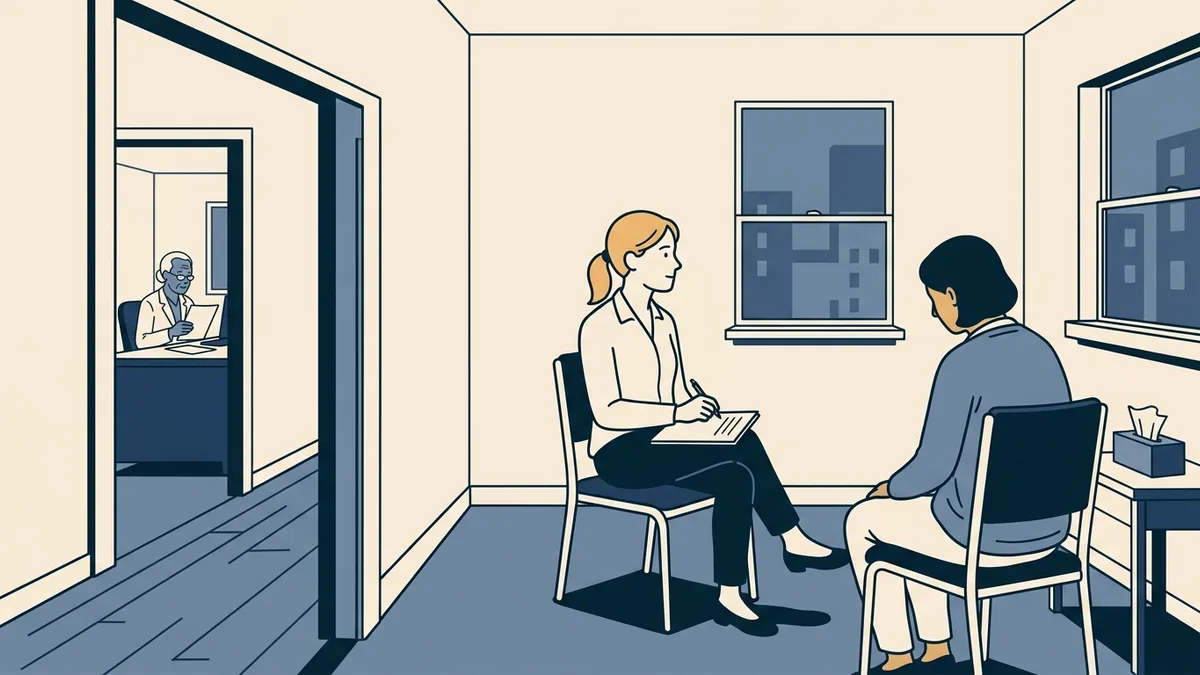
In many states an LMSW can provide psychotherapy, but only under a qualified clinical supervisor, typically as an employee of an agency or group practice. New York allows LMSW clinical work only under supervision and generally rejects self-hired supervisors. A solo therapy practice owned by the LMSW is usually not an option.
Usually yes, with two conditions that matter more than the title: a qualified supervisor, and a setting that lets that supervisor actually direct your work. What an LMSW usually cannot do is hang out a shingle and see therapy clients alone.
The details vary by state, and "LMSW" itself does not mean the same thing everywhere. In Michigan, for instance, the LMSW is the top license and can carry a clinical designation (see Michigan's LMSW). In most other states it is the master's-level license that comes before the clinical one. The second meaning is the one that matters here.
How does New York draw the line?
New York's rules are the most often quoted and among the clearest. The State Education Department's FAQ says "the LMSW may only provide 'clinical social work' services (diagnosis, psychotherapy, and assessment-based treatment planning) under supervision; the LCSW may provide those services without supervision." The supervisor shares responsibility for each client and may need to be on-site for joint intakes or direct observation.
New York also restricts how that supervision is arranged. NYSED calls arrangements where an LMSW "hires or contracts with a licensee to provide supervision" problematic and "as a general rule, unacceptable," because a supervisor you pay cannot independently direct your practice. NASW's New York chapter adds that LMSWs "are not allowed to establish a private practice or professional entity" to provide clinical social work services.
New York's BSWs have it narrower still: they can practice licensed master social work under supervision but "may not practice clinical social work, including diagnosis and psychotherapy, even under the supervision of an LCSW."
What about Maryland and Texas?
Maryland. Asked whether an LMSW may provide teletherapy, the Board of Social Work Examiners answers: "Yes, under the supervision of a Board Approved LCSW-C Supervisor." The supervisor must hold the board's supervisor approval in addition to an LCSW-C.
Texas. The clinical route runs through an LCSW Supervisor (LCSW-S). The Behavioral Health Executive Council requires at least 3,000 hours of supervised practice under an LCSW-S, with at least 100 hours of supervision over no less than 24 full months, before the LCSW. That supervised practice is where a Texas LMSW does clinical work.
Other states follow the same broad pattern with different paperwork. Some, like Texas and Maryland, require the supervisor to hold a board supervisor designation; see supervisor designations. Check the license guide for your state before you accept a job.
Why is private practice usually off the table?
Because clinical practice by an LMSW is legal only under supervision, and supervision has to be real. A solo practice owned by the LMSW leaves no one with authority over the clinical decisions. New York prohibits it outright. In other states the rules are often less explicit, but the logic is the same wherever an LMSW's clinical work must be supervised: a practice the LMSW owns and runs alone has no one in a position to supervise it. Ask your board before assuming otherwise. Group practices that employ LMSWs under an LCSW are a different arrangement, and a common one.
Can an LMSW bill insurance for therapy?
Not Medicare, directly. Medicare's definition of a clinical social worker, in 42 CFR 410.73, requires a master's or doctorate in social work, at least two years of supervised clinical social work, and a state license or certification as a clinical social worker. A master's-level license on its own does not meet it. Commercial plans and Medicaid programs set their own rules, which vary by state and by plan. We cover that in can an LMSW bill insurance?
So what should an LMSW who wants to do therapy do?
Take a job where clinical supervision is part of the role and the hours count toward the clinical license. Confirm in writing that your supervisor qualifies under your board's rules, that any required plan is filed, and that your hours are logged the way the board will want them. Then get to the clinical license; it is the credential that makes therapy yours to practice independently. See LMSW vs. LCSW and documenting supervision.
When you have the hours, our LMSW-to-LCSW Clinical License Upgrade handles the application, the Clinical exam approval and the supervision verifications. See pricing.
Common questions
- Can an LMSW diagnose clients?
- Only under supervision where the state allows it. In New York, diagnosis is clinical social work, which an LMSW may perform only under a qualified supervisor; the LCSW performs it independently.
- Can an LMSW open a private practice?
- Not for clinical services in New York. Elsewhere, wherever an LMSW's clinical work must be supervised, a solo practice the LMSW owns has no one to supervise it. Ask your board, and treat non-clinical consulting as a separate question.
- Can an LMSW pay for their own clinical supervisor?
- It depends on the state. New York calls supervisor arrangements an LMSW hires or contracts for problematic and generally unacceptable. Other states allow private supervision if the supervisor qualifies under board rules.
- Can an LMSW bill Medicare for therapy?
- No. Medicare covers clinical social workers, defined in 42 CFR 410.73 as having two years of supervised clinical experience and a state clinical license or certification.
Need Help with Your Application?
We handle the social work licensing process end-to-end — eligibility screening, documents, board follow-ups, and tracking.