
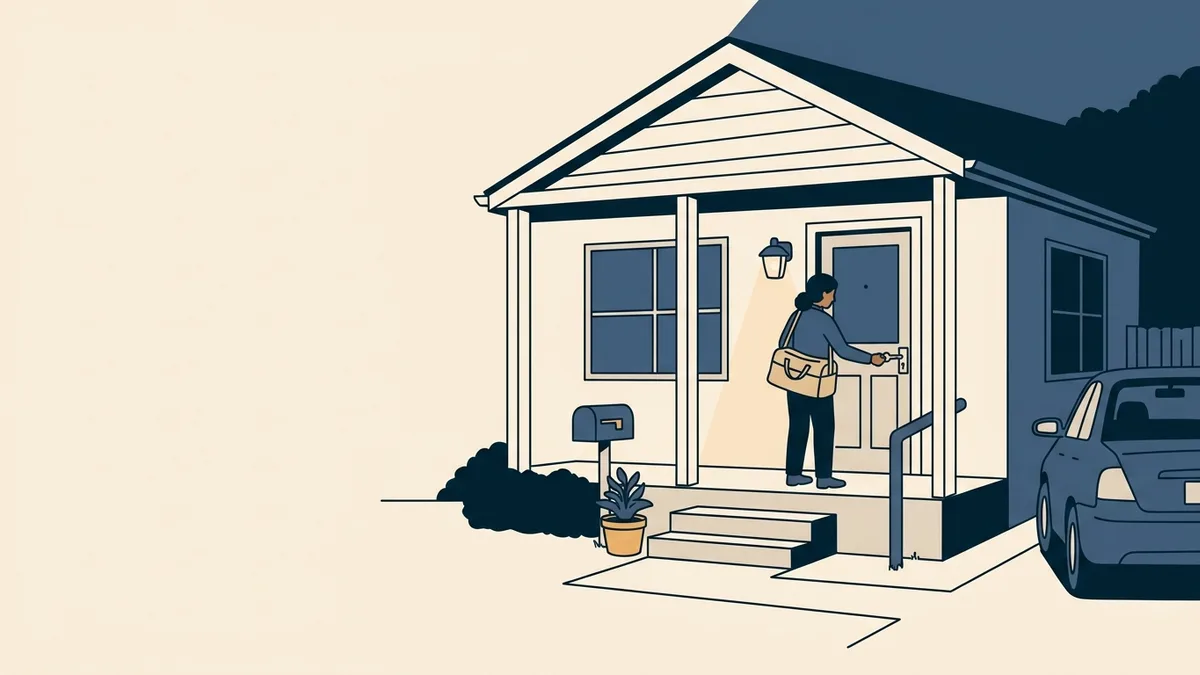
Your home state under the Social Work Compact is the member state of your primary domicile, where you live and intend to stay. Where you work, where you were first licensed and where your clients are do not count. You can have only one home state, and if you live in a non-member state, you cannot use the compact.
Every question about who can use the Social Work Licensure Compact comes back to one term: home state. The model law defines it as "the Member State that is the Licensee's primary Domicile," and defines domicile as "the jurisdiction in which the Licensee resides and intends to remain indefinitely." The Commission's FAQ puts it more plainly: "The social worker's home state must be where their primary residence is located."
That sounds simple. In practice it is the rule social workers most often get wrong, because it ignores the things people instinctively count.
What does not make a state your home state?
- Where your office is. A social worker who lives in Kansas and commutes to a clinic in Missouri has Kansas as the home state.
- Where you were first licensed. If you trained and were licensed in Ohio and moved to Kentucky, Kentucky is your home state once you live there, whatever your Ohio license says.
- Where you hold a license. Holding a license in a member state you do not live in gives you a single-state license there and nothing more.
- Where your clients are. A telehealth caseload that is mostly in one state does not move your home state.
- Where your employer is incorporated. Group practices and platforms sometimes assume their state of registration controls. It does not.
Can I have two home states?
No. The model law says a licensee "shall have only one Home State, and only one Multistate License." You can still hold as many single-state licenses as you like; the compact expressly does not interfere with that. Only one of them can be the base for a multistate license.
What if I live in a state that is not a member?
Then you cannot use the compact, even if you hold a license in a member state. This is the most common disappointment. A social worker who lives in Texas, holds licenses in Texas and Oklahoma, and hoped to turn the Oklahoma license into a multistate license cannot do it. Oklahoma is not where they live, and Texas is not a member.
The rule applies at the border, too. Someone who lives in New York City and works in New Jersey has New York as the home state for compact purposes. New Jersey has enacted the compact; New York has not. The compact does nothing for that person until New York joins or they move.
If you are in that position, your options are single-state licenses in the states you need. See how to get a license in another state and whether to get a second license now or wait.
What evidence of domicile will a board want?
The Commission has not published a list for initial applications. Its rule on changing home states, adopted in September 2026, gives a hint of the approach: the reissuance application asks for a physical address evidencing domicile in the new state and an attestation that you no longer claim domicile in the prior one. Expect your board to ask for an address and a sworn statement, and to be able to ask for more. Keep ordinary proof handy: a driver's license, voter registration, a lease or deed, and state tax filings that agree with each other.
Situations that need a closer look
Two residences
Social workers who split the year between two states have to pick the one that is their primary domicile, and the rest of their life should match: tax residency, driver's license, voter registration. Choosing a home state for the compact that contradicts your tax return is asking for a problem.
Recent movers
If you move between member states after you hold a multistate license, you apply to the new home state for reissuance within 30 days of establishing domicile there, and you keep the prior state's license active until the new one issues. See Moving to a new home state.
Military families
The compact has a specific rule: an active military member or spouse designates a home state where they hold a multistate license and may keep it for as long as the service member is on active duty, even when orders take them elsewhere. Details in Social work licensing for military spouses.
Living abroad
The compact covers states, the District of Columbia and US territories. A social worker living overseas has no member home state. Practicing with clients in the US from abroad still needs a license in the client's state.
Why the compact insists on this
The design puts discipline and oversight in one place. The home state checks eligibility, runs the background check, enforces continuing education and holds the license that every remote state relies on. If a home state encumbers the license, authorization in every remote state is deactivated. A social worker who could pick any member state as a base could shop for the most lenient board, which is exactly what the domicile rule prevents.
Check your own situation
Before the compact goes live, it is worth confirming three things: that your domicile is in a member state, that your home-state license is at a level that qualifies (see is an LMSW or bachelor's license eligible?), and that your target states are members. The Compact Readiness Review covers all three for $149, and you can look up any state on our state license pages.
Common questions
- I live in a non-compact state but hold a license in a compact state. Can I use the compact?
- No. Your home state must be the member state where you primarily live. A license in a member state you do not live in remains a single-state license.
- Can I choose which state is my home state for the Social Work Compact?
- Only in the sense of choosing where you live. The home state is your primary domicile. Active military members and their spouses can keep a designated home state while on active duty.
- If I work in one state and live in another, which is my home state?
- The state where you live. If that state is not a member, the compact is not available to you, even if your workplace is in a member state.
Need Help with Your Application?
We handle the social work licensing process end-to-end — eligibility screening, documents, board follow-ups, and tracking.